


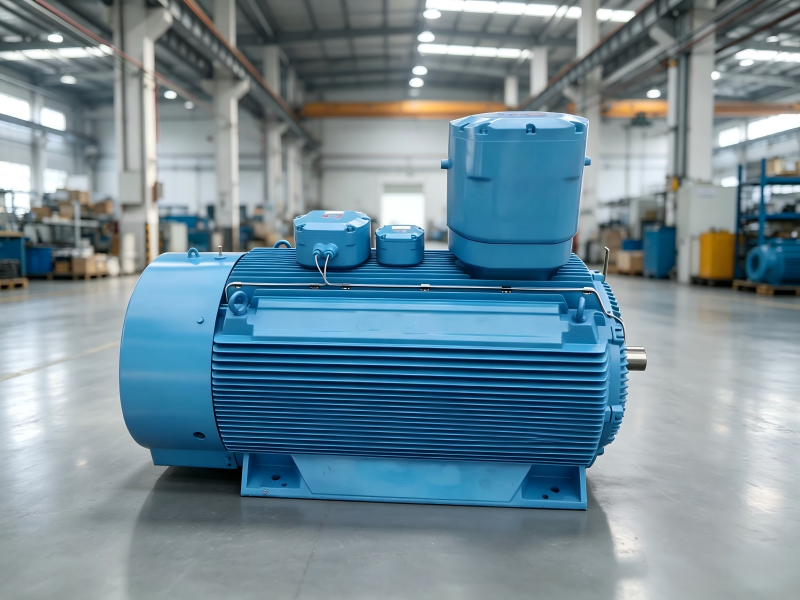
Why Choose HT Motors: Advantages and Use Cases
While low-voltage motors have a wide range of potential uses in industry, there are still situations where higher voltages are required to do the job.
Control Limitations
There may be different ideas about what constitutes a low-voltage, medium-voltage, or high-voltage motor.
Some people consider any voltage above 1000 V to be high voltage. However, the limits are clearly defined in the IEC 60038 standard: low voltage up to 1000 V, medium voltage from 1000 V to 35 kV, and high voltage over 35 kV. Therefore, the motors in the new ZCL product line fall into the medium- and high-voltage categories.
Advantages and Use of HT Motors
HT Slip Ring Induction Motor
Cost Savings
Medium and high voltage are particularly suitable for heavy-duty applications, which require motors with an output power of 400 kW and more. Here, higher voltages allow the use of smaller cables and thus significantly reduce distribution cable costs.
By increasing the voltage, the current can be reduced. This means that smaller distribution cables can be used. If cables have to be laid over long distances, for example in tunnels, higher voltages are also an obvious choice.
Industries
HT motors are particularly suitable for professionals working with heavy loads. They are ideally suited for the HVAC industry, such as industrial fan and screw compressor manufacturers, as well as the pump industry.
Advantages and Use of HT Motors
Insulation Systems
The stators on HT motors have an improved insulation system for medium- and high-voltage use. This includes a vacuum impregnation system where all recesses are filled with varnish and corona protection material to prevent electrical wear of the insulation material. In addition, the creepage distances and air gaps from conductor to earth are greater.
In contrast to low-voltage motors, HT motors do not have terminal connection plates, but are connected using high-voltage insulators.
Electrical and Thermal Life Testing
The higher the voltage, the greater the effect on motor life. Therefore, in-depth documentation and testing are required for the quality assurance of the motor.
Our HT motors are tested for both electrical and thermal life. We have documentation for all motors with a service life of at least 20,000 hours.
If variable speed is required, motors with current-insulated bearings can be installed, as used in low-voltage motors, so the service life can be further extended due to the reduced bearing current.
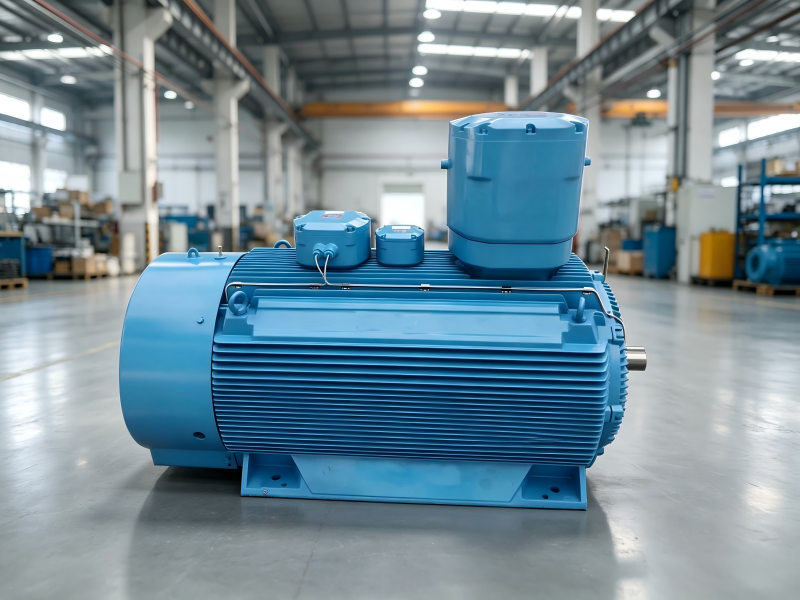
Advantages and Use of HT Motors
HT Rib-Cooled Motors
Authorized Installation
While most electricians can connect low-voltage motors, using higher voltages is more complicated. Therefore, the use of HT motors requires thorough advice and close dialogue.
You will need special authorization to install an HT motor and establish an electrical connection. Our sales staff and our technical department are ready to provide support, for example in selecting the right type of motor and establishing the electrical connections, including clamps and cables.
Too High or Too Low
Too high a voltage can cause premature failure of electrical and electronic components, such as circuit boards, due to overheating. The damage caused by overheating is cumulative and irreversible. Motors, on the other hand, can often benefit from voltages that tend to be a bit high. The reason is simple. As the voltage level increases, the current decreases, and lower current usually means less heat generated within the motor windings.
Low voltages are also a major cause of motor overheating and premature failure. Low voltages force the motor to draw additional current to provide the expected power, thus overheating the motor windings.
