


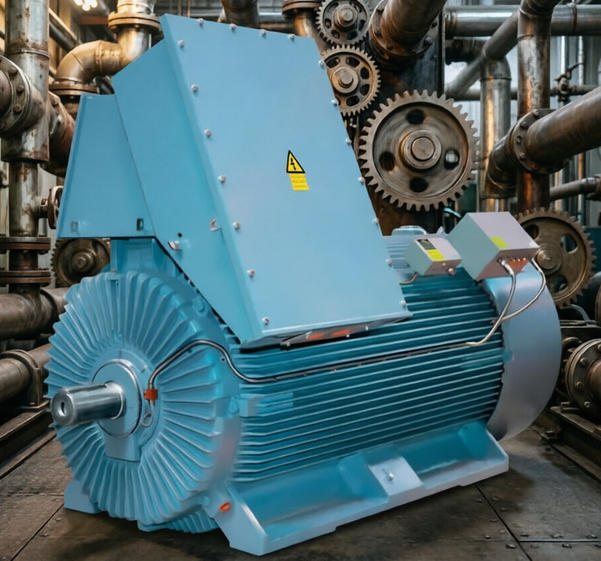
Synchronous vs Asynchronous Generator What Are Advantages and Disadvantages
When selecting a generator for power generation, understanding the difference between synchronous vs asynchronous generator technologies is essential. Both convert mechanical energy into electrical energy, but they differ in rotor construction, speed behavior, voltage control, efficiency, and grid interaction.
What Are Synchronous and Asynchronous Generators?
Synchronous Generator
A synchronous generator produces electricity with a rotor speed that is strictly synchronized with the grid frequency. Its output frequency depends directly on rotor speed and the number of poles, following the relationship:
n = 60f / p
where n is rotor speed, f is frequency, and p is the number of pole pairs.
Synchronous generators are widely used in thermal power plants, hydroelectric stations, nuclear power plants, diesel generator sets, and large renewable energy systems.
Asynchronous Generator
An asynchronous generator, also called an induction generator, operates with a rotor speed that is not strictly locked to grid frequency. It normally runs at a speed slightly above synchronous speed when generating power, creating what is known as negative slip.
Asynchronous generators are commonly used in small hydropower systems, wind turbines, distributed generation, and applications where variable speed operation and simple construction are advantageous.
Working Principle of a Synchronous Generator
In a synchronous generator, the rotor is supplied with DC excitation or uses permanent magnets to create a stable magnetic field. When the rotor is driven by a prime mover such as a turbine or engine, its magnetic field rotates relative to the stator windings. This induces an alternating voltage in the stator.
Because the rotor rotates at synchronous speed, the generated voltage frequency remains stable and directly tied to rotor speed. The output voltage can be controlled by adjusting the excitation current, making synchronous generators well suited for grid-connected power generation.
Working Principle of an Asynchronous Generator
An asynchronous generator usually has a squirrel-cage or wound rotor without independent DC excitation. When the rotor is driven faster than synchronous speed by an external prime mover, electromagnetic induction produces current in the rotor. This induces power in the stator windings.
Unlike synchronous generators, asynchronous generators cannot independently control output voltage or frequency. They generally require connection to a grid or an external reactive power source to establish the magnetic field.
Advantages and Disadvantages of Synchronous Generators
Advantages
- Stable frequency output: Rotor speed is locked to grid frequency, ensuring stable power quality.
- Adjustable voltage: Output voltage can be regulated by changing excitation current.
- Power factor control: Can supply or absorb reactive power, helping stabilize the grid.
- High efficiency at rated load: Large synchronous generators typically achieve high conversion efficiency.
- Suitable for large-scale power generation: Widely used in thermal, hydro, nuclear, and diesel power plants.
Disadvantages
- More complex structure: Requires excitation systems, automatic voltage regulators, or permanent magnet rotors.
- Higher cost: Generally more expensive than asynchronous generators of similar capacity.
- More demanding synchronization: Grid connection requires matching voltage, frequency, phase, and phase sequence.
- Higher maintenance in some designs: Excitation brushes, slip rings, or control systems may increase maintenance needs.
Advantages and Disadvantages of Asynchronous Generators
Advantages
- Simple and rugged construction: Often uses a squirrel-cage rotor with no separate excitation system.
- Lower cost: Easier to manufacture and maintain.
- Simple grid connection: Can connect to the grid without complex synchronization procedures.
- Good speed flexibility: Can operate over a limited speed range, making it suitable for wind and hydro applications.
- Low maintenance: Fewer rotating electrical components compared with many synchronous designs.
Disadvantages
- Cannot operate independently: Usually requires a grid or external reactive power source for excitation.
- Poor voltage regulation: Output voltage depends on grid conditions and reactive power supply.
- Lagging power factor: Typically absorbs reactive power, which may require capacitors or power electronics.
- Lower peak efficiency: Slip causes additional rotor losses compared with synchronous generators.
- Limited fault contribution: Provides less sustained fault current than synchronous generators.
Synchronous vs Asynchronous Generator: Key Differences
| Feature | Synchronous Generator | Asynchronous Generator |
|---|---|---|
| Speed | Runs at synchronous speed; strictly linked to frequency | Runs above or below synchronous speed with slip |
| Excitation | Requires DC excitation or permanent magnets | Relies on electromagnetic induction |
| Voltage Control | Can be adjusted through excitation | Depends on grid or external reactive power |
| Power Factor | Adjustable; can support grid reactive power | Usually lagging; absorbs reactive power |
| Grid Connection | Requires synchronization of voltage, frequency, and phase | Simpler connection but needs reactive support |
| Efficiency | Higher efficiency at rated load | Slightly lower due to slip losses |
| Cost | Higher initial cost | Lower cost and simpler maintenance |
| Typical Use | Power plants, large generators, stable grid supply | Wind power, small hydro, distributed generation |
How to Choose Between Synchronous and Asynchronous Generators
Choose a synchronous generator if the application requires stable frequency, precise voltage regulation, reactive power support, or large-scale grid-connected power generation. These generators are the standard choice for thermal, hydro, nuclear, and diesel power systems.
Choose an asynchronous generator if the priority is low cost, simple structure, low maintenance, and operation in variable-speed renewable energy systems. They are especially common in wind turbines, small hydropower plants, and distributed generation projects.
In summary, the choice in a synchronous vs asynchronous generator comparison depends on grid requirements, control precision, efficiency targets, cost limits, and the type of prime mover. Synchronous generators offer superior control and stability, while asynchronous generators provide simplicity, robustness, and cost advantages.
