





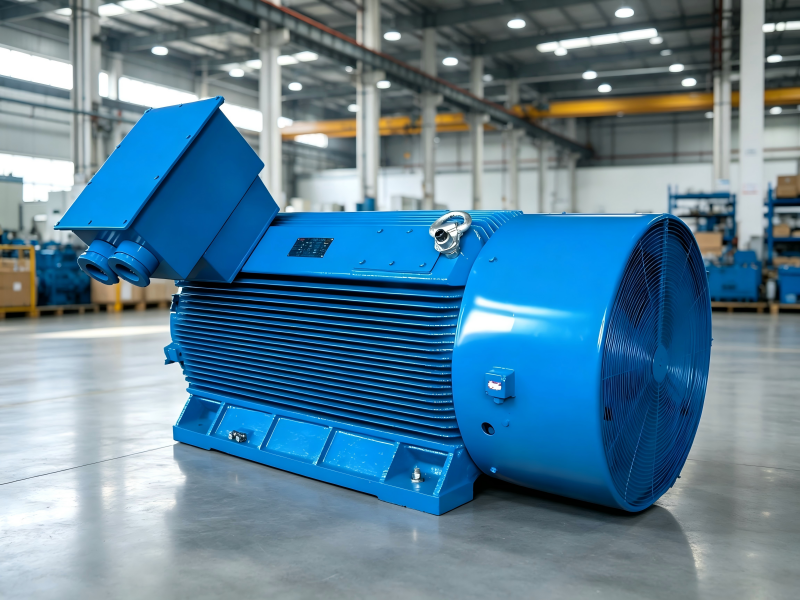
Synchronous Motors: Basics and Operating Principles
Synchronous Motor
A synchronous motor belongs to the category of alternating current (AC) motors. Its rotor rotates at exactly the same speed as the rotating magnetic field generated by the stator. This means the running speed of a synchronous motor stays constant and synchronizes with the frequency of the power supply. In simple terms, the rotor achieves magnetic locking with the stator’s rotating magnetic field. Thanks to this feature, a synchronous motor is highly suitable for scenarios requiring precise speed regulation.
Most electric motors convert electrical energy into mechanical motion, yet they operate through vastly different mechanisms. Although all motors realize energy conversion, engineers have developed multiple motor types to meet diverse practical demands. Some synchronous motors run on direct current (DC), some rely on alternating current, and others adopt hybrid power supply modes. Each type possesses unique energy transfer characteristics. Therefore, DC motors and AC motors cover many classifications, and a synchronous motor stands out among AC motor varieties with distinctive strengths.
A synchronous motor is specially developed to overcome the limitations of induction motors, another widely used type of AC motor. As the name suggests, an induction motor generates mechanical power via electromagnetic induction. However, it inevitably produces slip — a speed difference between the rotating magnetic field and the rotor. Slip is an inherent outcome of the induction working principle. While slip exerts little influence on most ordinary working conditions, it makes induction motors unable to maintain accurate rotational speed. For this reason, induction motors are also called asynchronous motors.
By contrast, a synchronous motor features an output rotating speed strictly matching the frequency of the input alternating current. A synchronous motor can be applied to clocks, rolling mills, record players and other equipment, since its rotating speed maintains a fixed proportional relationship with the power supply frequency. In terms of power level and model diversity, a synchronous motor cannot compare with an induction motor. Nevertheless, a synchronous motor occupies an irreplaceable position in all equipment that needs accurate timing and constant rotational speed.
Key Components of a Synchronous Motor
The stable and efficient operation of a synchronous motor depends on the coordinated work of multiple core components. The main components and their functions are listed below:
- Stator The stator is the stationary part of a synchronous motor. It is stacked with silicon steel laminations and internally provided with slots for embedding windings. The stator undertakes the core task of generating the rotating magnetic field required for the operation of a synchronous motor.
- Stator Winding The stator winding is generally manufactured using high-grade enameled copper wire. It is arranged in three-phase star connection or delta connection and installed inside stator slots. When three-phase alternating current is fed into the stator winding, a rotating magnetic field is produced.
- Rotor The rotor is the rotating component of a synchronous motor. It adopts a cylindrical structure with magnetic poles distributed on the outer surface. Similar to the stator, the rotor is assembled by silicon steel laminations to optimize magnetic performance and reduce energy loss.
- Rotor Winding The rotor winding is wound on the magnetic poles of the rotor with enameled copper wire. Direct current provided by the exciter energizes the rotor winding and generates a steady magnetic field. This magnetic field enables the rotor to lock synchronously with the stator’s rotating magnetic field.
- Exciter The exciter is a small-capacity DC shunt generator mounted on the same shaft as the rotor. During the operation of a synchronous motor, the exciter outputs direct current and supplies power to the rotor winding, forming a self-sustaining excitation current supply system.
- Slip-Rings and Brushes A synchronous motor is equipped with two phosphor bronze slip-rings installed on the rotor shaft. Carbon brushes keep continuous contact with slip-rings, transmitting DC excitation current from the exciter to the rotor winding and ensuring smooth and efficient power transmission.
Main Characteristics of a Synchronous Motor
- A synchronous motor cannot start automatically. It needs external driving force to raise the rotor speed close to synchronous speed before realizing synchronization.
- When the power frequency remains unchanged, the operating speed of a synchronous motor keeps synchronous with the power frequency. No matter how the load changes, a synchronous motor runs at a constant speed.
- A synchronous motor has a prominent unique advantage: it can work under different power factors. This property allows a synchronous motor to be used for power factor improvement of power grids.
Working Principle of a Synchronous Motor
A synchronous motor is a doubly excited machine with two independent electrical inputs. Its stator winding accesses three-phase alternating current, and the rotor winding receives direct current. The three-phase current flowing through the stator winding generates a rotating magnetic field; the direct current on the rotor creates a constant magnetic field.
At any instant, the magnetic poles of the rotor and the stator may be homopolar and generate repulsive force. At the next instant, heteropoles appear and produce attractive force. Restricted by rotor inertia, the alternating attraction and repulsion cannot drive the stationary rotor to rotate. This explains why a synchronous motor lacks self-starting capability.
Normally, external mechanical force is adopted to drive the rotor, making it rotate in the same direction as the stator rotating magnetic field at a speed approaching synchronous speed. Once the rotor reaches synchronous speed, magnetic locking takes effect. After removing the external driving force, the synchronous motor can continue steady rotation.
Types of a Synchronous Motor
According to different rotor excitation modes, a synchronous motor can be divided into non-excited synchronous motor and current-excited synchronous motor.
Non-excited Synchronous Motor
This type of synchronous motor does not need external excitation voltage. Its rotor is made of ferromagnetic materials to interact with the stator magnetic field. It mainly includes three types: hysteresis motor, synchronous reluctance motor and permanent magnet synchronous motor.
- Hysteresis motor: The rotor base is made of non-magnetic materials wrapped with a ferromagnetic hysteresis ring. The stator rotating magnetic field induces magnetic poles on the hysteresis ring. Affected by hysteresis loss, the rotor magnetic field lags behind the stator magnetic field, forming an included angle and generating driving torque. This kind of synchronous motor runs quietly and is widely used in record players, tape recorders and other audio equipment.
- Synchronous reluctance motor: It relies on magnetic attraction and reluctance effect to output torque. The stator structure is equipped with salient poles embedded with coils. The rotor is made of ferromagnetic metal with specially designed grooves and magnetic barriers. The rotor tends to rotate to the position with minimum magnetic reluctance, thus producing reluctance torque. After being pulled into synchronous speed, this synchronous motor can achieve precise rotation.
- Permanent magnet synchronous motor: Permanent magnets are embedded in the rotor to form a stable constant magnetic field. The permanent magnetic field interacts with the stator rotating magnetic field to drive rotation. To adjust the speed and torque of this synchronous motor, a variable frequency drive is essential to change the frequency of stator alternating current.
Current-excited Synchronous Motor
The typical representative is DC-excited synchronous motor. It requires both AC power supply for the stator and DC power supply for the rotor. The rotor is equipped with windings similar to stator windings. After accessing direct current, the rotor windings generate a constant magnetic field, complete magnetic pole alignment with the stator rotating magnetic field and achieve synchronous operation. Most high-power synchronous motors above 1 horsepower belong to this category, which is also the most common form of a synchronous motor in industry.
Applications of a Synchronous Motor
- A synchronous motor can operate under leading or lagging power factors. When running without load, a synchronous motor presents a leading power factor. Therefore, a synchronous motor can be connected to power systems to improve power factor, applicable to occasions where static capacitors cannot be deployed.
- A synchronous motor is suitable for low-speed and high-power working conditions, such as rolling mills, chippers, agitators, large pumps, compressors and other equipment.
- A synchronous motor is irreplaceable in modern industry. Without a synchronous motor, many timing devices including clocks, record players, vehicle windscreen wipers, hard disk drives, signal equipment and recording instruments cannot work normally. Besides providing constant rotating speed, a synchronous motor can also optimize the low efficiency of induction motors and reduce power transmission losses. Although a synchronous motor has higher cost and more complex structure compared with an induction motor, its advantages in power factor correction and speed accuracy make a synchronous motor an important driving device for engineering designers.
Summary
This paper systematically introduces the definition, internal structure, operating principle, classification and application scenarios of a synchronous motor. It hopes this introduction about a synchronous motor can bring you valuable reference. If you want to know more relevant product information of a synchronous motor, you are welcome to contact us.
