


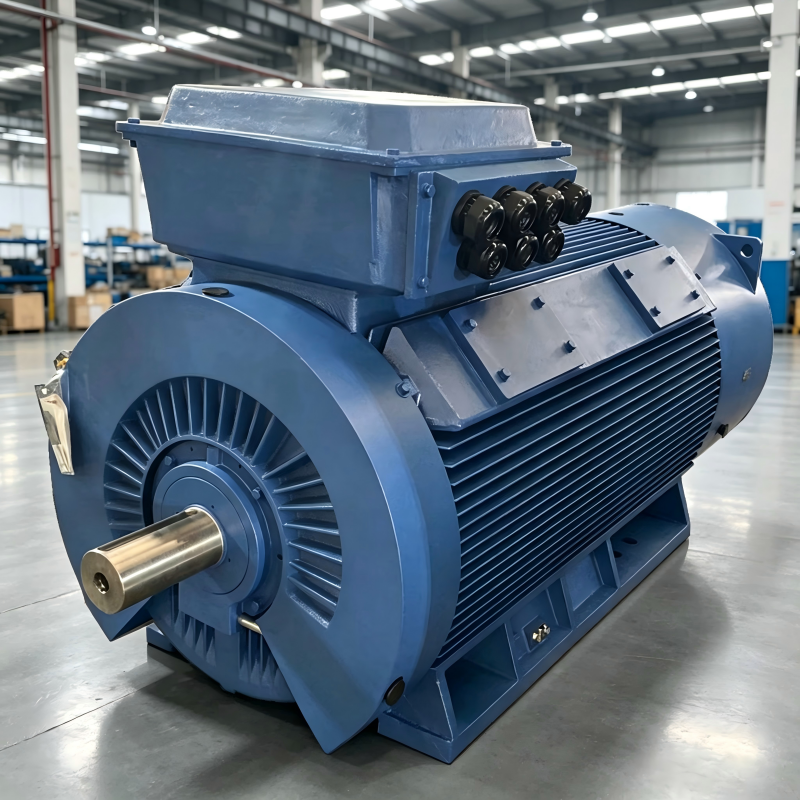
Squirrel Cage Motor vs Wound Rotor Motor: Which Is Better?
Both squirrel cage motors and wound rotor motors are types of induction motors, but they differ mainly in rotor construction, starting behavior, speed control, maintenance needs, cost, and typical applications.
🟦 Squirrel Cage Motor
A squirrel cage motor is the most common type of induction motor. Its rotor consists of aluminum or copper bars shorted at both ends by end rings, forming a cage-like structure. The rotor is not connected to an external power source; instead, it rotates because the stator’s magnetic field induces current in the rotor bars.
Key features
- Simple and rugged construction
- Low manufacturing cost
- Low maintenance
- No slip rings or brushes
- Generally high efficiency at constant speed
- Suitable for fans, pumps, compressors, conveyors, and general industrial machinery
Main limitations
- Lower starting torque compared to wound rotor motors
- High starting current during direct-on-line starting
- Limited natural speed control unless a VFD is used
🟧 Wound Rotor Motor
A wound rotor motor, also called a slip ring motor, has a rotor with insulated windings similar to the stator winding. The rotor windings are connected to external resistors through slip rings and brushes. This allows external resistance to be added to the rotor circuit during starting or speed control.
Key features
- Higher starting torque
- Lower starting current when external resistance is used
- Better speed and torque control
- Suitable for heavy-load starting and high-inertia loads
- Commonly used in cranes, hoists, elevators, crushers, mills, and large industrial drives
Main limitations
- More complex construction
- Higher cost
- Requires maintenance for brushes and slip rings
- Generally less rugged than squirrel cage motors
️ Squirrel Cage Motor vs Wound Rotor Motor: Comparison Table
| Feature | Squirrel Cage Motor | Wound Rotor Motor |
|---|---|---|
| Rotor construction | Aluminum or copper bars shorted by end rings | Insulated windings connected through slip rings and brushes |
| External connection | No external rotor circuit | External resistance can be connected |
| Starting torque | Moderate to low | High and adjustable |
| Starting current | High during direct starting | Lower when external resistance is used |
| Speed control | Limited; mainly by VFD or pole changing | Better through rotor resistance or external control |
| Maintenance | Low | Higher due to brushes and slip rings |
| Cost | Lower | Higher |
| Durability | High | Moderate |
| Noise | Generally quieter | Can be noisier, especially during startup |
| Typical applications | Fans, pumps, compressors, general machinery | Cranes, hoists, elevators, crushers, heavy industrial drives |
Summary
A squirrel cage motor is preferred when simplicity, low cost, reliability, and low maintenance are more important than adjustable starting torque or speed control.
A wound rotor motor is preferred when high starting torque, smoother acceleration, or better speed/torque control is required, especially for heavy-load or high-inertia applications.
In short, squirrel cage motors are the default choice for most general-purpose applications, while wound rotor motors are used where starting performance and control flexibility are more critical.
