





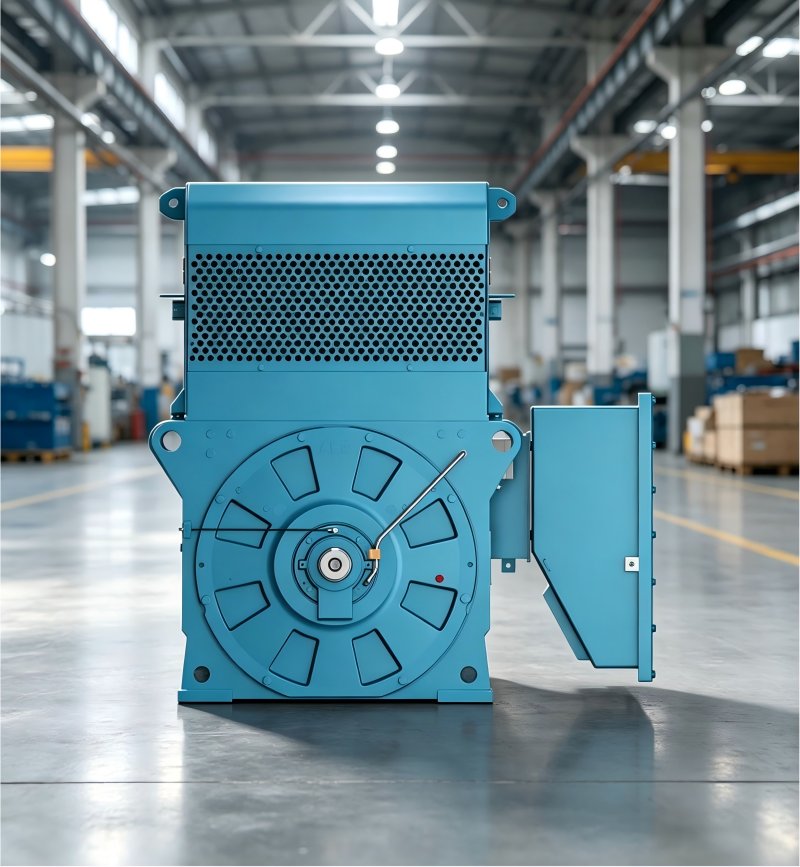
Motor PMSM – Permanent Magnet Synchronous Motor: Structure and Advantages
Permanent Magnet Synchronous Motor (PMSM) Overview
The Permanent Magnet Synchronous Motor (PMSM) is a high-performance AC motor that utilizes permanent magnets on the rotor to generate a constant magnetic field, eliminating the need for external excitation current. This design enables the rotor to rotate synchronously with the stator’s rotating magnetic field, delivering exceptional efficiency, power density, and control precision. PMSMs are widely adopted in electric vehicles, industrial automation, HVAC systems, and renewable energy applications due to their compact size, low noise, and superior dynamic response.
Structure of PMSM
The PMSM consists of a stator, rotor, and end covers. The stator features three-phase windings similar to conventional induction motors, generating a rotating magnetic field when energized. The rotor, however, is distinctively equipped with high-quality permanent magnets, which are critical to the motor’s performance. Based on magnet placement, PMSMs are categorized into two primary rotor structures:
- Surface-Mounted Rotor (SPM): Permanent magnets are affixed to the outer surface of the rotor core. This configuration offers a simple design and sinusoidal back-EMF, making it suitable for low-speed, high-precision applications. However, it has limited mechanical strength at high speeds and minimal asynchronous starting torque.
- Interior-Mounted Rotor (IPM): Permanent magnets are embedded within the rotor core, often in V-shaped or U-shaped slots. This structure combines permanent magnet torque with reluctance torque, enhancing power density, overload capacity, and field-weakening capability. IPM rotors are mechanically robust, making them ideal for high-speed and high-torque applications such as electric vehicle drivetrains.
Working Principle
The operation of a PMSM involves a two-stage process: starting and synchronous running. During startup, the stator’s rotating magnetic field induces currents in the rotor’s squirrel-cage windings (if present), generating asynchronous torque to accelerate the rotor from standstill. As the rotor approaches synchronous speed, the permanent magnet’s field aligns with the stator’s rotating field, producing synchronous torque that pulls the rotor into synchronization. Once synchronized, the rotor windings cease to function, and torque is solely generated by the interaction between the permanent magnet field and the stator field. This synchronous operation ensures zero slip, precise speed control, and minimal energy loss.
Key Advantages of PMSM
PMSMs offer significant performance benefits over traditional induction motors, particularly in energy efficiency and operational reliability:
- Low Losses and Temperature Rise: By eliminating excitation copper losses and rotor current, PMSMs achieve lower temperature rises (typically <20K under load) and reduced thermal stress, enhancing longevity and reliability.
- High Power Factor: PMSMs maintain a power factor close to 1.0 at full load, reducing stator current and copper losses. This allows for downsizing of power supply equipment and cables, lowering system costs.
- Superior Efficiency: PMSMs sustain >90% efficiency across 25%–120% load ranges, outperforming induction motors in light-load conditions. This wide high-efficiency band is critical for applications like fans and pumps, where motors often operate below 70% rated power.
- Enhanced Dynamic Performance: PMSMs provide high starting torque, rapid acceleration, and stable speed regulation unaffected by load or voltage fluctuations. Their synchronous nature ensures excellent dynamic response, making them ideal for variable-frequency drives and precision motion control.
- Standardized Integration: PMSMs comply with IEC installation dimensions, enabling direct replacement of induction motors. They support IP54/IP55 protection ratings and are available in explosion-proof variants for hazardous environments.
Applications and Industry Adoption
PMSMs have achieved widespread adoption in medium- and low-voltage applications across metallurgy, ceramics, rubber, petroleum, and textile industries. Their design and operational expertise have matured, enabling reliable performance in demanding industrial settings. In emerging sectors, PMSMs are pivotal in electric vehicle propulsion, industrial robotics, wind turbine generators, and high-efficiency HVAC compressors. As permanent magnet materials and control technologies advance, PMSMs continue to drive innovation in energy-efficient and high-precision electromechanical systems.
