





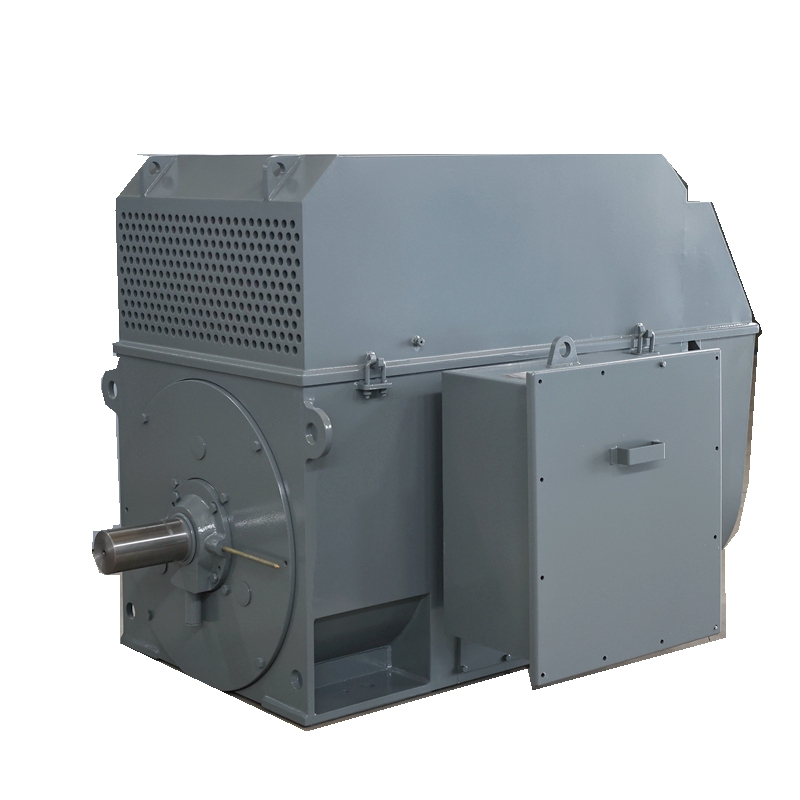
Induction vs Synchronous Motor What Do You Want to Know
The first step when selecting a motor is confirming your power supply: will it run on AC or DC? This splits motor selections into two core groups, AC Motors and DC Motors, filtering out units incompatible with your existing electrical infrastructure. Both groups include numerous motor variants, so this guide focuses on breaking down AC motor options. Within AC motor classifications sit induction motors and synchronous motors. This article outlines both motor types, comparing their working principles, performance traits and real‑world use cases.
Induction Motors
Induction motors rank among the most widely deployed AC motors across modern industry. As one of the earliest invented motor designs, they have undergone long‑term optimization to suit a huge range of operating scenarios. Their construction is fairly straightforward, made up of an outer stator and an inner rotor. Mechanical rotation is generated via electromagnetic induction interaction between these two components.
Different induction motor subtypes generate rotation through slight variations, yet the core operating principle stays consistent. Alternating current feeds into stator windings to build up a rotating magnetic field driven by the oscillation frequency of the AC supply. This rotating magnetic field induces a counter magnetic field within the rotor, the freely rotating armature linked to the output shaft, and generates usable mechanical torque. Get a free quotation.
Induction motors are also known as asynchronous motors. The shaft rotation speed never perfectly aligns with the input AC frequency. This difference is defined as slip. Slip arises because the rotor continuously chases the rotating magnetic field. Due to slip characteristics, induction motors cannot deliver highly precise speed control. Available in countless configurations covering different speeds, torque ratings, voltages and frame sizes, induction motors are widely adopted for home appliances, electric vehicles and heavy‑duty industrial machinery.
Synchronous Motors
Synchronous motors make up for the performance limitations caused by slip in induction motors. Their output shaft rotational speed strictly synchronizes with the input AC frequency. This feature makes them ideal for precision‑critical applications including timing clocks, rolling mills and record players. Stator and rotor magnetic poles lock together, so the stator‑generated rotating magnetic field spins the rotor at an exact fixed synchronous speed.
Synchronous motors lack inherent self‑starting capability. Most models rely on dedicated motor starters to bring rotors up to rated operating speed. Induction motors need no such auxiliary starters, as they can kick off directly from stand‑still. Additionally, synchronous motors cannot adjust speed easily. Operators must fit an AC motor controller to modify running speed. Though synchronous motors carry higher upfront costs compared with induction motors, they boast superior efficiency. They are preferred solutions for crushers, mills, grinders and other low‑speed, high‑power working conditions.
Induction vs Synchronous Motor Core Comparison
Simplicity is the key competitive advantage of induction motors against synchronous alternatives. Easy manufacturing, reliable operation and low‑maintenance requirements keep induction motor purchase costs far lower. By contrast, synchronous motors adopt more sophisticated rotor structures, bringing higher manufacturing and maintenance workloads. Extra supporting circuits are also required to guarantee stable, efficient operation.
As noted above, induction motors feature self‑start performance while standard synchronous motors do not. Induction motors need fewer peripheral accessories for normal operation, cutting overall system cost and complexity.
Power density refers to output power per unit motor volume. For identical frame sizes, synchronous motors deliver higher power density, producing greater power within compact dimensions. This advantage fits space‑limited installations and forms a major reason to select synchronous motors over induction counterparts.
Synchronous motors can reach efficiency levels above 90%, generally outperforming induction motors in energy saving. Actual efficiency varies according to specific motor model and dimension. Zero‑slip operation cuts energy loss during electric‑to‑mechanical power conversion for synchronous designs.
Cost gap remains a major consideration between induction vs synchronous motor solutions. Synchronous motors incur higher expenses across production, system integration, maintenance and repair. Nevertheless, their energy‑saving performance and power‑factor correction ability may offset the higher initial investment. Whether the long‑term benefits justify the premium depends heavily on your actual working conditions. Project planning should always evaluate full life‑cycle costs to achieve minimum total expenditure.
