





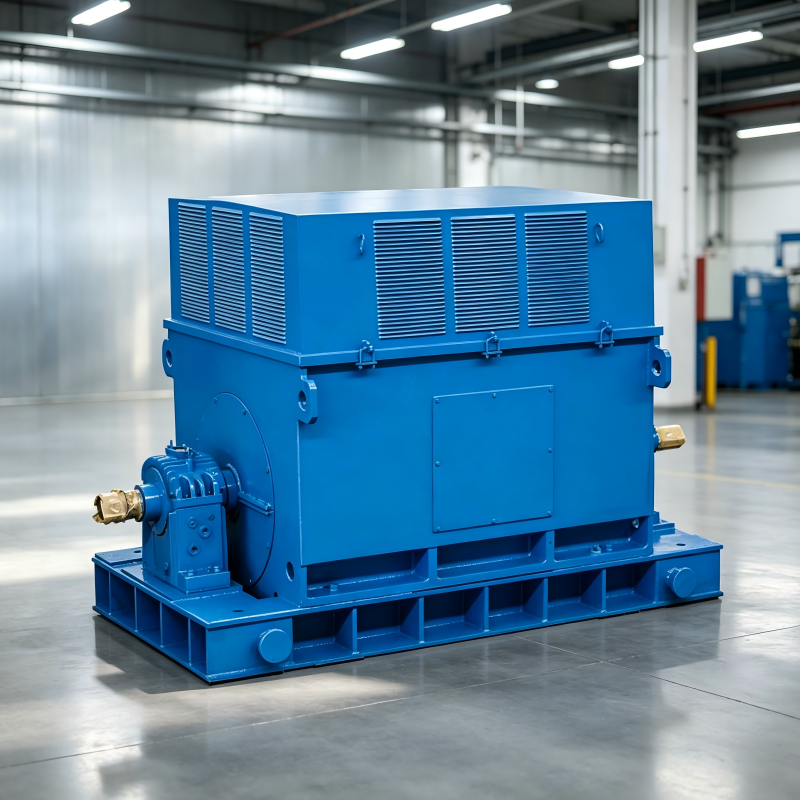
Induction vs Synchronous Motor: Everything You Want to Know
The starting point for selecting a suitable motor is confirming your power source: alternating current (AC) or direct current (DC). This basic criterion splits motor products into two major groups, AC motors and DC motors, filtering out any units incompatible with your existing electrical system. Even so, each group includes numerous motor variants. This guide focuses on further sorting out AC motor options. Within AC motor classification, you will find induction motors and synchronous motors. This article gives concise introductions for both types, alongside comparisons covering operational features and real‑world use cases.
Induction Motors
Induction motors rank among the most widely adopted AC motors across modern industrial scenarios. As one of the earliest‑invented motor solutions, they have gone through long‑term optimization to fit diverse working conditions. Their mechanical layout is fairly straightforward, built with an outer stator and an inner rotor. Mechanical rotation is generated via electromagnetic induction between these two core components.
Different sub‑types of induction motors realize rotation through slightly different mechanisms. Generally speaking, alternating current flows through stator windings and generates a magnetic field. The oscillation frequency of AC supply drives continuous rotation of this magnetic field. The rotating magnetic field further induces a counter magnetic field inside the freely‑moving rotor connected to the output shaft, which creates practical rotational power. Get a free quotation.
Also known as asynchronous motors, induction motors run with output shaft rotation speed inconsistent with input AC frequency. This key characteristic is defined as slip. The rotor constantly chases the rotating magnetic field, which gives rise to slip effect. Due to slip, induction motors cannot deliver highly precise speed synchronization. Available in hundreds of variants with different speed, torque, voltage, dimension and configuration parameters, induction motors are extensively applied in home appliances, electric vehicles and heavy‑duty industrial machinery.
Synchronous Motors
Synchronous motors make up for the performance limitations brought by slip in induction motors. Their output rotational speed strictly aligns with input AC frequency, making them ideal for scenarios demanding accurate timing, such as clocks, rolling mills and turntable equipment. Stator and rotor magnetic poles work in coordination, so the stator rotating magnetic field spins the rotor at fully synchronized speed.
Synchronous motors lack self‑starting capability in most circumstances. External motor starters are required to bring rotors up to rated operating speed. By contrast, induction motors can start directly from static status without extra startup assistance. Besides, synchronous motor speed cannot be adjusted easily. Operators need an AC motor controller to modify running speed. Though synchronous motors normally carry higher purchase costs, they feature superior efficiency and perform well for low‑speed high‑power equipment including crushers, mills and grinders.
Core Comparison: Induction vs Synchronous Motor
Simplicity constitutes the primary competitive advantage of induction motors against synchronous alternatives. Induction motors are easy to produce, run and service, resulting in much lower overall costs. On the contrary, synchronous motors adopt sophisticated rotor structures that raise manufacturing and maintenance difficulty. Additional supporting circuits are also mandatory to guarantee stable high‑efficiency operation.
As noted above, induction motors feature inherent self‑starting performance while synchronous motors do not. Induction motors need fewer auxiliary peripheral parts, cutting total system cost and mechanical complexity.
Power density refers to output power per unit motor volume. Under equivalent dimensional conditions, synchronous motors deliver higher power density, outputting greater power within compact housing. This merit fits installations with strict space limits and serves as a major reason users pick synchronous motors over induction types.
Synchronous motors can reach efficiency above 90% in many working conditions and generally outperform induction motors on energy saving. Actual efficiency varies according to exact motor model and frame size. Zero‑slip design helps synchronous motors reduce energy loss during electric‑to‑mechanical power conversion.
Cost gap remains a noticeable distinction between induction and synchronous motors. Synchronous motors bear higher expenditure in production, system deployment, routine maintenance and part repair. Nevertheless, their energy‑saving performance and power factor correction capacity may offset the high initial investment. You need to evaluate according to your actual working conditions. For any engineering project, full‑life‑cycle cost control should always be a key consideration.
