





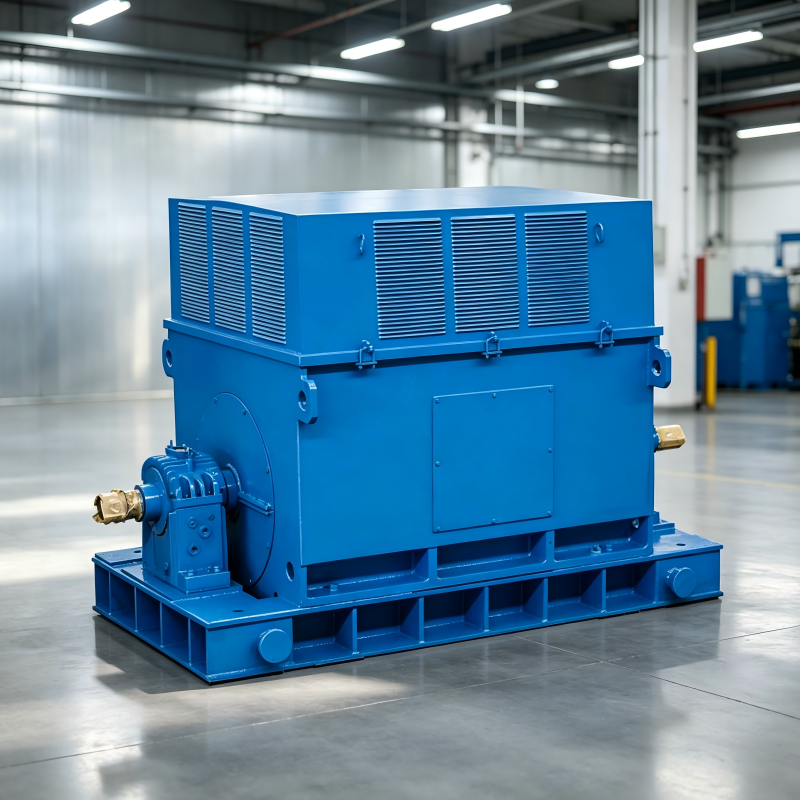
Induction Motor vs Synchronous Motors: What Do You Want to Know?
When selecting an AC motor, the very first consideration is your power source. Once you confirm AC supply, you will mainly choose between two mainstream options: induction motor and synchronous motor. Understanding their core differences in working principles, performance traits and practical applications helps you pick the right unit for your operating conditions.
Induction Motor
The induction motor ranks among the most widely‑adopted AC motors across modern industrial sectors. Dating back to early motor inventions, it has undergone long‑term optimization to fit countless operating scenarios. Its mechanical layout is straightforward, built with an outer stator and an inner rotor, and mechanical rotation is generated via electromagnetic induction.
In general working logic, alternating current flows through stator coils to build up a rotating magnetic field driven by AC supply frequency. This rotating magnetic field induces a counter magnetic field within the rotor connected to the output shaft, and then drives shaft rotation.
One key feature of induction motors is slip. The rotor rotational speed never perfectly matches the input AC frequency, as the rotor constantly chases the rotating magnetic field. Due to slip effects, induction motors cannot deliver highly precise speed synchronization.
These motors feature inherent self‑starting capability and can ramp up from static status without extra starting excitation devices. They are available in extensive ranges of torque, speed, voltage and frame sizes. You can find them in home appliances, electric vehicles and heavy‑duty industrial machinery. Simple fabrication, easy operation and low‑maintenance requirements make induction motors cost‑effective for most general‑purpose uses.
Synchronous Motor
Different from induction types, a synchronous motor runs its rotor at exactly the same rotational frequency as the input AC power supply. There is zero slip during normal operation. The stator rotating magnetic field locks magnetically with rotor poles, so the output shaft maintains strict speed synchronization. This characteristic makes it ideal for precision‑demanding scenarios including clocks, rolling mills and record‑playing equipment.
Synchronous motors cannot start by themselves in most cases. Auxiliary starting devices are required to bring the rotor up to rated operating speed. Speed adjustment also relies on dedicated AC motor controllers, since its natural running speed is fixed by supply frequency.
Though synchronous motors usually come with higher upfront expenditure, they deliver outstanding energy efficiency. Many models achieve over 90 % efficiency. Without slip‑related energy waste in electro‑mechanical energy conversion, they perform excellently for low‑speed, high‑power workloads such as crushers, mills and grinders. They also boast higher power density: for identical physical dimensions, synchronous motors output more power, which suits installations with limited space.
Core Comparison: Induction Motor vs Synchronous Motor
Manufacturing and field maintenance set these two motor types apart significantly. Induction motors own uncomplicated rotor structures, leading to low production cost and minimal maintenance workload. Synchronous motors need sophisticated rotor assemblies plus supporting auxiliary circuits for stable operation, raising procurement and servicing complexity.
Self‑starting performance creates another obvious gap. Induction motors start directly from standstill with fewer peripheral accessories, cutting overall system expenses. Synchronous motors depend on external starters for rotor excitation to reach full speed.
Power density favors synchronous solutions. Equal‑frame‑size synchronous motors yield higher power output, which is a critical merit for space‑limited applications.
On energy efficiency, synchronous motors hold an advantage thanks to the absence of slip losses. Real‑world efficiency varies with motor model and dimension, yet synchronous units generally outperform induction counterparts.
Cost remains a major trade‑off point. Synchronous motors bear higher capital outlay, installation and repair costs. Nevertheless, their energy‑saving performance and power‑factor correction functions may offset high initial investment over the full service life. Project engineers need to evaluate total life‑cycle costs against actual working conditions before final motor selection.
SEO keywords:induction motor vs synchronous motor,ac induction motor,synchronous ac motor,induction motor working principle,synchronous motor working principle,ac motor selection,industrial ac motor,slip in induction motor,motor power density,motor life cycle cost
