


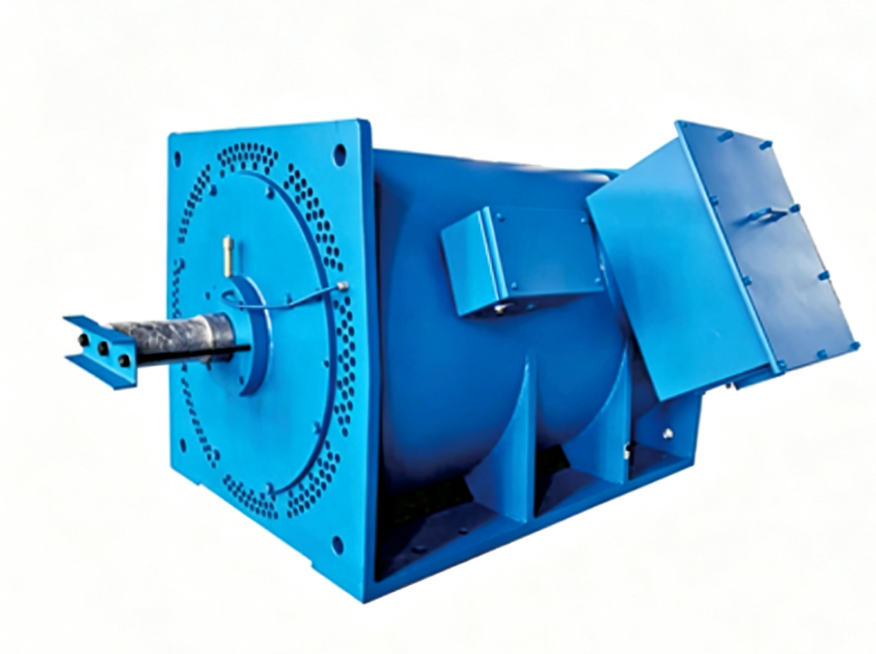
Different AC Motor Types, Working Principles and Core Components
An AC motor type represents essential machinery deployed across diverse industrial, commercial and residential scenarios. Two core assemblies define its construction: the stationary outer stator and the rotating inner rotor coupled to the motor shaft. Both parts interact to produce rotating magnetic fields, which constitute the cornerstone of motor operation. The rotating magnetic field of the stator is triggered by alternating current flowing through its internal windings.
Within different AC motor types, the stator winding fulfills dual roles, acting as both armature and field winding. Once AC voltage is applied to the stator, a rotating magnetic field spinning at synchronous speed comes into being. This magnetic field induces voltage across stator and rotor windings to drive motor function.
Types of AC Motor Types
Various AC motor types exist, each engineered for distinct operating scenarios. Major categories cover single‑phase, three‑phase, brake, synchronous, asynchronous, custom‑built, two‑speed and three‑speed motors. Their primary distinctions stem from target application scenarios and input power supply requirements.
Residential‑oriented AC motor types mostly run on single‑phase or double‑phase power supplies.
By contrast, industrial‑grade AC motor types commonly adopt three‑phase power input.
Such power‑supply differences mark the critical divide between industrial‑use and household‑use AC motor types.
The majority of AC motor types fall into the induction motor category. They produce torque via electromagnetic induction: the magnetic field from the stator excites current inside the rotor, which generates torque and triggers rotary motion.
Starting Solutions for Different AC Motor Types
Diverse starting approaches are adopted for AC motor types, determined by practical applications and motor classifications. These starting techniques regulate power input to realize soft startup and avoid electrical‑mechanical damage.
Contactor or Manual Starter
A contactor enables simple on‑off power control for AC motor types.
A manual starter puts operators in direct charge via physical switches for power adjustment.
Star‑Delta Starters: This solution cuts down initial startup voltage. At startup, stator windings adopt star (Y) connection to lower starting current. After the motor accelerates to preset speed, windings switch to delta (Δ) connection for full‑voltage operation.
Auto‑Transformer Starter: It also suppresses inrush current by lowering stator startup voltage. Multiple tap connections allow flexible adjustment of output torque and starting current to match practical demands.
Rotor Impedance Starter: It connects to rotors directly through slip rings and brushes. Rotor resistance is maximized at startup and gradually drops as rotation speeds up. Despite reliable performance, this starter tends to be bulky and high‑cost.
Soft Starters: They deliver smooth, gradual startup and shutdown, mitigating mechanical stress on motors and matched equipment. This fits scenarios where minimizing component wear is prioritized.
Key Components of AC Motor Types
Stator
The stator generates the rotating magnetic field required for motor operation. It comprises laminated metal cores, copper wire coils and connecting assemblies. Some AC motor types adopt squirrel‑cage rotor structures. Electric power feeds into stator copper coils to build magnetic fields that induce rotor current.
For three‑phase AC motor types, three groups of windings are spatially offset by 120°, fitted onto laminated iron cores. These windings guarantee steady, uninterrupted motor rotation.
Rotor
Unlike DC motors, rotors of AC motor types receive no direct external power supply; energy is obtained from the stator’s rotating magnetic field. Two mainstream rotor designs apply to three‑phase induction AC motor types:
Squirrel Cage Rotor: It consists of aluminum or copper rotor bars plus end rings. Variations in the stator magnetic field induce currents inside rotor bars and drive rotation. The rotor runs slower than the synchronous speed of AC input, creating “slip”, which is indispensable for torque generation.
Wound Rotor (Slip Ring) Motor: Its laminated cylindrical core is wound with coils similar to stator windings. Coil terminals link to shaft‑mounted slip rings, which make electrical contact with brushes. Operators can adjust motor speed and torque through slip‑ring circuits. Wound‑rotor AC motor types excel in precise performance tuning.
Squirrel Cage Rotor Working Mechanism
For AC motor types with squirrel‑cage rotors, rotor bars interact with the stator‑generated electromagnetic field. Fluctuating stator current changes electromagnetic flux, inducing rotor current and mechanical rotation. The rotor can never fully catch up with the stator magnetic field. Once rotation speed equals synchronous speed, electromagnetic induction disappears and the motor stalls.
Wound Rotor & Speed Regulation
Wound‑rotor AC motor types deliver superior speed‑adjustment flexibility. Belonging to asynchronous motors, their rotor speed lags behind stator synchronous speed, producing slip. Slip weakens the effective stator magnetic field during operation, achieving fine‑tuning over torque, rotating speed and overall performance. Hence these AC motor types are widely selected for tasks requiring strict speed‑torque adjustment.
Conclusion
AC motor types feature broad‑spectrum adaptability across industries. They generate torque through electromagnetic induction, with diversified structures including squirrel‑cage and wound‑rotor variants to satisfy various application needs. Whether single‑phase AC motor types for household use or heavy‑duty three‑phase induction AC motor types for industry, they provide stable and efficient output. Core parts such as stators and rotors cooperate closely to convert electric energy into mechanical rotation, forming the foundation for countless mechanical devices.
If you plan bulk purchasing among different AC motor types, the Y2‑series asynchronous motor (center height H80‑355 mm) brings prominent cost‑performance. This totally‑enclosed, self‑fan‑cooled squirrel‑cage three‑phase asynchronous motor serves as a general‑purpose low‑voltage solution. Optimized from classic Y‑series AC motor types, Y2 series achieves higher power output, larger starting torque, IP54 protection grade and Class‑F insulation for enhanced reliability. Benefiting from low‑noise design and IC411 cooling mode, it maintains stable high‑efficiency performance and complies with IEC standards on installation dimensions and power ratings.
