





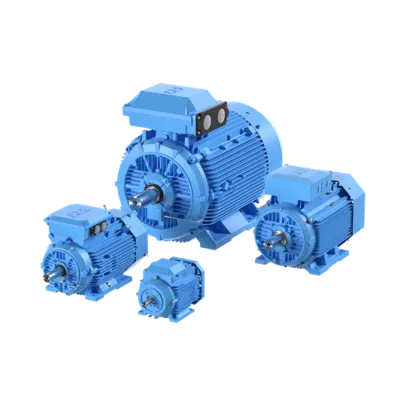
Asynchronous vs Synchronous Motors: Where Each One Shines
Electric motors power countless industrial, commercial, and residential applications, with synchronous and asynchronous (induction) motors being two of the most commonly used types. Each motor type offers distinct features, benefits, and best-use cases depending on application requirements. In this article, we'll explore the differences between asynchronous and synchronous motors and look at where each one is most effectively used.
How They Work
Synchronous Motor
A synchronous motor is a typical AC motor capable of generating synchronous speed. In these motors, both the stator and the rotor rotate at the same speed, thus achieving synchronization. The basic working principle is that when the motor is connected to a power source, current flows into the stator windings, generating a rotating electromagnetic field. This field is then induced into the rotor windings, causing the rotor to rotate.
An external DC power supply is required to lock the direction and position of the rotor to the direction and position of the stator. Because of this interlock, the motors must run synchronously or not run at all.
Asynchronous (Induction) Motor
The working principle of an induction motor is almost the same as that of a synchronous motor, except that the asynchronous motor is not connected to an external exciter. Asynchronous motors also operate on the principle of electromagnetic induction. In this case, the rotor does not receive any electrical energy through conduction like a DC motor.
The key difference is that there is no external device connected to the induction motor to cut off the rotor, so the rotor speed depends on the varying magnetic induction intensity. This changing electromagnetic field causes the rotor to rotate slower than the stator's magnetic field. Because the speed of the rotor and the speed of the stator's magnetic field differ, these motors are called asynchronous motors. The difference in speed is called slip.
Key Features
Synchronous Motor
- Precise Speed Control: Since synchronous motors run at a constant speed determined by the supply frequency, they're ideal for applications where maintaining a fixed speed is crucial.
- Efficiency: Synchronous motors can achieve high efficiency in specific applications, especially at high loads, due to their ability to operate without slip losses.
- Power Factor Control: Synchronous motors can adjust the power factor in an electrical system, which can improve energy efficiency and reduce utility costs.
Asynchronous (Induction) Motor
- Simplicity and Durability: Induction motors have a simpler design and fewer moving parts, making them robust and low-maintenance.
- Scalability: Available in a wide range of sizes, asynchronous motors can power everything from small appliances to large industrial machines.
- Cost-Effectiveness: Due to their relatively simple construction and high reliability, asynchronous motors are generally more affordable than synchronous motors.
Asynchronous vs Synchronous Motors: Advantages and Disadvantages
- The synchronous motor runs at a given frequency and a constant speed, independent of the load. However, the speed of an asynchronous motor will decrease as the load increases.
- Synchronous motors can run with larger power factors, including lag and lead, while asynchronous motors always run with a lagging power factor. When the load is reduced, the lagging power factor may become very low.
- Synchronous motors are not self-starting, whereas asynchronous motors are self-starting.
- Like an asynchronous motor, the torque of a synchronous motor is not affected by voltage changes.
- To start a synchronous motor, an external DC excitation is required, but an asynchronous motor can run without any external excitation.
- Synchronous motors are generally more expensive and complicated than asynchronous motors, while asynchronous motors are cheaper and user-friendly.
- Synchronous motors are particularly suitable for low-speed drives because their power factor can always be adjusted to 1.0 and their efficiency is high. On the other hand, asynchronous motors are useful for speeds above 600 RPM.
- Unlike asynchronous motors, synchronous motors can run at ultra-low speeds by using high-power electronic converters that generate very low frequencies. They can be used to drive crushers, rotary kilns, and variable-speed ball mills.
Asynchronous vs Synchronous Motors: Where Are They Used?
Applications of Synchronous Motors
- They are usually used in power stations to obtain the proper power factor. They work in parallel with the bus and are usually over-excited externally to achieve the required power factor.
- They are also used in the manufacturing industry, where a large number of asynchronous motors and transformers are used, to overcome the problem of power factor lag.
- Used in power stations to generate electricity at the required frequency.
- Used to control the voltage by changing the excitation in the transmission line.
Applications of Asynchronous Motors
More than 90% of the motors in the world are asynchronous motors, and they have been widely used in various fields. Some of them include:
- Centrifugal fans, blowers, and pumps
- Compressors
- Conveyors
- Lifts and heavy cranes
- Lathes
- Petroleum, textile, and paper mills
Choosing Between Asynchronous and Synchronous Motors
Selecting the right motor type depends on application requirements:
- Precision and Consistency in Speed: For applications that demand precise and consistent speed, synchronous motors are generally preferred.
- Cost and Durability: For applications where cost-effectiveness and durability are prioritized over precision, asynchronous motors are ideal.
- Power Factor Requirements: In industrial setups where power factor correction is needed, synchronous motors can be advantageous.
- Variable Loads and Variable Speeds: Asynchronous motors are better suited for applications with varying loads and speed requirements, making them the more flexible option in many general-purpose uses.
Conclusion
Asynchronous and synchronous motors each have specific characteristics and advantages that make them suitable for different applications. Synchronous motors excel in environments requiring precision and stability, such as industrial equipment and generators, while asynchronous motors are more versatile, economical, and widely used in various industrial and consumer applications. Understanding these distinctions helps in choosing the right motor for each application, ultimately improving performance, efficiency, and cost-effectiveness.
