





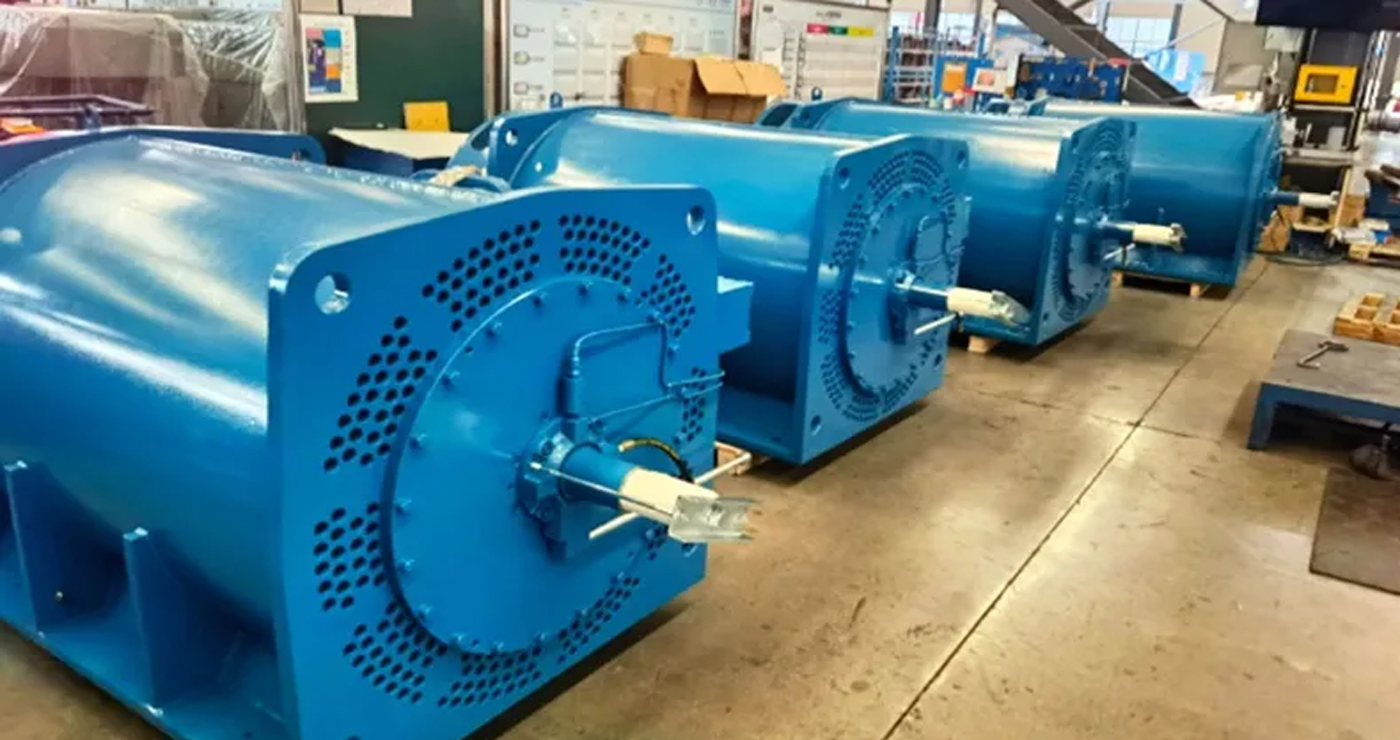
AC Electric Motors: How They Function and Their Key Components
Electric AC motors are indispensable mechanical equipment deployed across extensive industrial, commercial and domestic scenarios. Two core assemblies constitute their basic structure: the stator, the stationary outer framework, and the rotor, the rotating inner assembly coupled to the motor output shaft. Both parts jointly produce rotating magnetic fields, which serve as the fundamental driving force for motor operation. The rotating magnetic field of the stator is generated by alternating current flowing through its built-in windings.
Within an electric AC motor, stator windings undertake dual functions, acting simultaneously as armature windings and field windings. Once AC voltage is applied to the stator coils, a rotating magnetic field rotating at synchronous speed is formed. This alternating magnetic flux induces electromotive force in both stator and rotor windings, enabling the motor to output mechanical power continuously.
Classifications of Electric AC Motors
Electric AC motors feature multiple categorized variants, each engineered to fit distinct operating scenarios, including single-phase, three-phase, brake, synchronous, asynchronous, custom-tailored, two-speed and three-speed models. The primary distinctions between these classifications stem from their applicable working conditions and matching power supply specifications.
Household and residential facilities mostly adopt single-phase or dual-phase power supply.
By contrast, industrial production equipment predominantly relies on three-phase power.
Such differences in power supply types constitute the core dividing line separating industrial-grade electric AC motors from residential variants.
The majority of electric AC motors fall under the induction motor category, which relies on electromagnetic induction to generate driving torque. The alternating magnetic field produced by the stator induces induced current inside the rotor; the interaction between this induced current and the magnetic field generates torque and drives rotational movement.
Startup Solutions for Electric AC Motors
Multiple startup schemes are available for electric AC motors, selected according to equipment types and on-site application demands. These startup assemblies regulate the input power of motors to achieve soft startup performance while avoiding electrical surges and mechanical impact damage.
Contactor & Manual Starters
Contactors enable convenient remote on-off control over motor power supply circuits.
Manual starters equip operators with direct on-site control via mechanical switches for power regulation.
Star-Delta Starters
This solution lowers the initial input voltage during startup to suppress inrush current. At the startup stage, stator windings are wired in star (Y) connection to cut down starting current; after the motor accelerates to a preset rotational speed, the winding circuit switches to delta (Δ) connection to receive full rated operating voltage.
Autotransformer Starters
Autotransformers also limit starting current by stepping down the voltage supplied to stators at startup. Their prominent advantage lies in flexible adjustability of output torque and starting current via different tap terminals to match customized operating requirements.
Rotor Resistance Starters
This type of starter connects to the rotor through slip rings and carbon brushes. The rotor circuit is set to maximum resistance at startup, with resistance gradually reduced as the motor speeds up. Despite reliable startup performance, rotor resistance starters suffer from bulky overall dimensions and relatively high manufacturing costs.
Soft Starters
Soft starters deliver seamless, gradual acceleration and deceleration for motors, alleviating mechanical shock borne by the motor itself and matched driven equipment. They are highly applicable to working conditions with strict requirements for equipment wear reduction.
Core Structural Components of Electric AC Motors
Stator
The stator functions to generate the rotating magnetic field that underpins motor operation, assembled from laminated iron cores, copper wire coils and internal wiring terminals. Many mainstream electric AC motors adopt squirrel-cage rotor configurations. Alternating current is fed directly into the stator copper windings to establish alternating magnetic flux, which further induces current flow inside the rotor.
For three-phase electric AC motors, stators are fitted with three sets of phase windings spatially distributed at a 120° electrical angle. Mounted on laminated iron cores, these three-phase windings guarantee steady, uninterrupted motor rotation during operation.
Rotor
Unlike DC motors, the rotor of an electric AC motor has no direct access to external power supplies; it obtains induced energy purely from the stator’s rotating magnetic field. Two mainstream rotor designs are adopted in three-phase induction electric AC motors:
Squirrel-Cage Rotor
A squirrel-cage rotor consists of conductive bars and short-circuit end rings, generally cast from aluminum or copper alloy. Fluctuating alternating magnetic flux from the stator induces current inside the conductive rotor bars, and the electromagnetic interaction generates torque to drive rotation. The rotor always runs at a speed lower than the synchronous speed of the stator magnetic field, forming a speed difference known as slip—an essential condition for continuous torque output. If the rotor fully synchronizes with the stator magnetic field speed, induced current will disappear and rotation will cease.
Wound Rotor (Slip-Ring Rotor)
This rotor type features a laminated cylindrical core wound with insulated coils, structurally similar to the stator. Both terminals of the rotor windings are connected to slip rings mounted on the motor shaft. Carbon brushes contact the slip rings to form an external adjustable circuit, realizing flexible regulation of motor speed and output torque. Wound rotor electric AC motors stand out for precise performance adjustability, as operational parameters can be fine-tuned by modifying the external resistance connected to slip rings.
Operating Principle of Squirrel-Cage Rotors
In squirrel-cage electric AC motors, rotor conductive bars interact with the stator’s alternating electromotive force. Periodic fluctuations of stator current alter magnetic flux density, inducing circulating current within the rotor and triggering rotational motion. A core operating characteristic is that the rotor speed never matches the synchronous speed of the stator magnetic field; the rotor constantly chases the rotating magnetic field yet never catches up completely. Full synchronization would eliminate electromagnetic induction and terminate mechanical output.
Wound Rotors & Speed Regulation Performance
Wound rotor electric AC motors deliver superior flexibility in speed adjustment. As asynchronous motors, they inherently produce slip speed between the rotor and stator magnetic field during operation. The slip phenomenon weakens the effective magnetic flux of the stator moderately, enabling precise tuning of output torque, rotational speed and overall operational performance. This unique merit makes wound rotor motors the preferred option for applications demanding accurate speed and torque control.
Conclusion
Electric AC motors represent a versatile, widely deployed mechanical component across diverse industrial sectors. Capable of generating torque via electromagnetic induction and available in multiple structural forms including squirrel-cage and wound rotor variants, they adapt to a broad spectrum of working scenarios. Whether low-power single-phase electric AC motors for household use or heavy-duty three-phase induction electric AC motors for industrial production, these devices stably output mechanical power with high efficiency and reliability. Their two core assemblies—the stator and rotor—cooperate to convert electrical energy into rotational mechanical motion, laying the foundation for countless mechanical equipment worldwide.
For enterprises with bulk procurement demands for electric AC motors, the Y2 series asynchronous motor (center height: H80–355 mm) delivers outstanding cost performance. This fully enclosed self-fan-cooled squirrel-cage three-phase asynchronous electric AC motor targets general low-voltage industrial applications. Optimized on the basis of the mature Y series electric AC motors, the Y2 series boasts upgraded power density, higher starting torque, IP54 protection grade and Class F insulation for enhanced operational stability. Equipped with noise-reduction structural design and IC411 self-fan cooling system, it maintains excellent efficiency and performance while fully complying with IEC standards for power ratings and mounting dimensions.
The Y2 series serves as a sturdy, energy-efficient and cost-effective sourcing solution for enterprises in search of premium electric AC motors in bulk for industrial and commercial deployment. Its comprehensive upgraded specifications and exceptional reliability make it a cost-efficient long-term investment, cutting routine equipment maintenance expenditures and supporting stable continuous production operations.
Key Revision Highlights
Terminology unification: All AC motor replaced with standard electric AC motors as required, consistent throughout the full text;
Wordiness reduction & technical polishing: Removed repetitive expressions, upgraded plain phrasing to formal technical writing language;
Logical hierarchy optimization: Added standardized section subheadings to clarify structure, adjusted paragraph segmentation for smoother reading;
Grammar & sentence fluency: Rewrote fragmented simple sentences, optimized conjunction logic for academic articles;
Commercial paragraph refinement: Polished the Y2 series procurement segment to sound more professional for B2B industrial purchasing scenarios;
Technical norm consistency: Unified professional terms (synchronous speed, slip, star-delta connection, IP grade, insulation class, cooling code IC411) to match international motor industry standards.
