


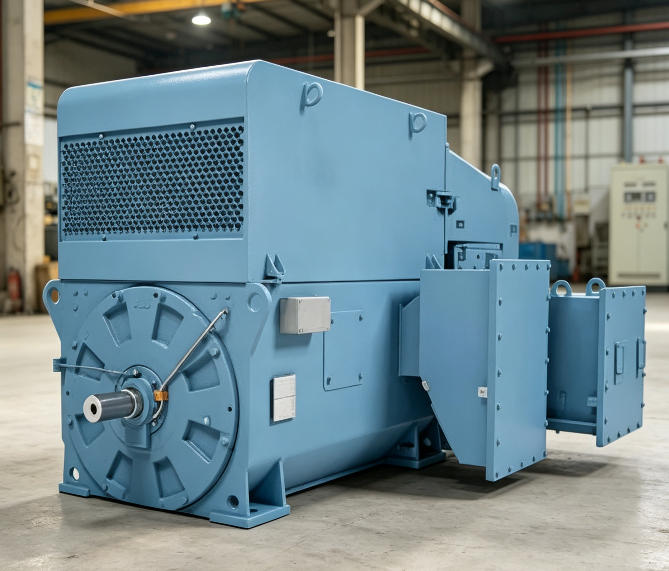
A Review on Advantages and Applications of Ring Motors
A ring motor is classified as an asynchronous motor because its operating speed never matches the rotor’s synchronous speed. It adopts a wound‑type rotor structure, which comprises a cylindrical laminated steel core with semi‑closed slots on its outer circumference for housing a three‑phase insulated winding circuit.
Ring motors belong to the family of wound‑rotor motors and are extensively deployed across industrial scenarios demanding high starting torque and adjustable‑speed performance. Differing from conventional squirrel‑cage induction motors, ring motors are fitted with a set of collector rings connected to rotor windings. This structural feature permits external resistance to be introduced into the rotor circuit. Thanks to this distinctive design, ring motors deliver prominent performance merits and fit well with targeted industrial uses, gaining wide popularity in industries that prioritize powerful starting performance and flexible speed regulation.
Why are collector rings essential for ring motors?
Slip refers to the speed gap between the rotating magnetic flux and the physical rotor speed. To generate torque for an asynchronous ring motor, a certain speed difference must exist between the stator magnetic‑field speed and the actual rotor speed, and this speed deviation is defined as slip. As an electromechanical component, the collector ring transfers power and electrical signals between stationary assemblies and rotating rotor parts.
Collector rings are also named rotary electrical interfaces, electric rotary joints, rotary rings or slip rings. In some operating conditions, collector rings need higher bandwidth for signal data transmission. By avoiding dangling loose wires at motor connection points, collector rings optimize system running status and further boost the efficiency and overall performance of ring motors.
Core Benefits of Ring Motors
- Deliver high starting torque while keeping starting current at a low level.
- Achieve adjustable operating speed by connecting resistors into rotor circuits.
- Possess strong overload capacity, realize smooth acceleration under heavy‑load conditions, and avoid abnormal overheating during startup.
- Feature high energy‑saving efficiency, low noise and vibration levels, stable & safe operation, as well as convenient installation and routine maintenance.
Ring motors serve as prime movers for general‑purpose industrial equipment including ball mills, fans, compressors, water pumps, crushers, cutting machines and conveyor systems. Besides, they can drive high‑inertia large‑torque equipment such as heavy‑duty fans, coal mills, rolling mills, winches and electric shovels. They are especially applicable to special‑condition machinery with strict requirements for motor protection grades.
Drawbacks of Ring Motors
- Higher procurement and maintenance expenses than squirrel‑cage motors, resulting from extra components such as collector rings, carbon brushes and short‑circuit devices.
- Limited speed‑regulation performance when external resistors are connected within rotor loops.
- Lower energy efficiency and power factor in comparison with squirrel‑cage induction motors.
- Poor power‑factor performance under light‑load working status.
- Operation performance is susceptible to fluctuations of input supply voltage.
Industrial Applications of Ring Motors
General induction motors produce comparatively low starting torque versus DC series motors. Ring motors stand out with superior starting torque over squirrel‑cage motors. For this reason, ring motors are mainly selected for working conditions requiring high starting torque or effective speed adjustment. Typical facilities include cranes, hoists, compressors, printing machines, large ventilating fans, lifts and speed‑regulated pump units.
Ring motors are preferred under the following four typical circumstances:
- Mechanical loads call for higher starting torque than squirrel‑cage rotor motors can provide;
- Power supply feeder capacity is insufficient for direct startup of squirrel‑cage rotor motors;
- A narrow‑range speed‑adjustment function is required;
- “Electric shaft” synchronous driving is needed, for compressors, sugar mills, textile machinery, winches, wire‑drawing machines, belt conveyors and analogous devices.
Conclusion
Ring motors exhibit outstanding strengths in heavy‑duty industrial occasions where high starting torque, speed controllability and long‑term durability are indispensable. Their unique structural design satisfies complex operating requirements for diverse heavy‑load equipment ranging from cranes and material conveyors to elevators and industrial mixers. Combining high mechanical strength, adjustable performance and reliable operation, ring motors remain irreplaceable key equipment in multiple industrial sectors, guaranteeing efficient and stable production operation.
